
Every month, a handful of my domains come up for renewal. Each time, the decision is the same: renew a domain for another year, or let it go. Most of my names are .coms, and over the years I’ve settled into a routine for making that call. There’s no formula or spreadsheet score. It’s a short set of questions, and sometimes a gut feeling.
Here’s how I do it.
I review a month ahead, in batches
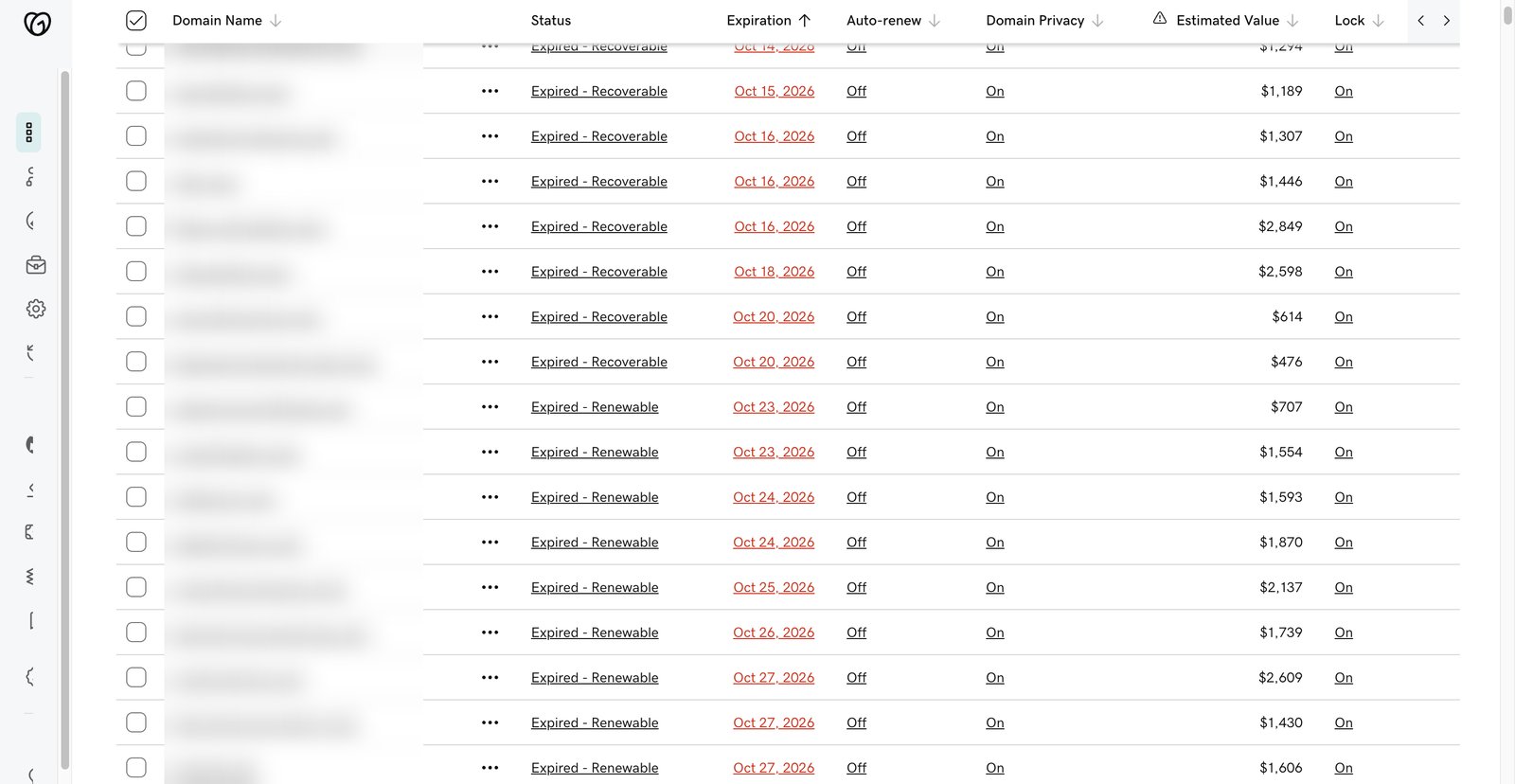
I don’t have a hard rule about how long I’ll hold a name. What I do have is a routine: I review names at least 30 days before they expire, and I do them in batches, not one at a time. In the first week of November, for example, I sit down and go through every domain expiring in December. I’ve set a nagging reminder on my phone so I don’t forget, because forgetting is going to cost me money.
A month’s head start gives me time to think, to check a few things, and to try selling a name I’ve decided not to keep.
Waiting to renew a domain until after it expires is a gamble. Registrars have to send at least two renewal reminders before a domain expires, and ICANN describes those as coming roughly one month and one week ahead. After expiry, a registrar may offer an Auto Renew Grace Period of 1 to 45 days, but it isn’t guaranteed, it can come with a fee, and ICANN warns that your registrar may auction the name to someone else during that window. ICANN’s policy also requires the registrar to disrupt the domain’s DNS before deleting it (ICANN’s summary for registrants says for up to 8 days), so anything running on the name stops working.
Once a gTLD name like a .com is deleted, there’s a 30-day Redemption Grace Period when the owner can still restore it, though the registrar may charge a fee for that. After that comes Pending Delete: a final five days when nobody can renew or restore it. Then the name is released and anyone can register it.
So I decide early, while all the options are still cheap.
1. Has anyone shown interest?
The first thing I look at is views and offers on Afternic or Sedo. If people are looking at a name, or better, making offers on it (real ones, not the spam kind), that’s the strongest reason to keep it. I also look at traffic. A name that gets visitors on its own is telling me something.
Interest or an offer is usually all it takes for me to renew a domain. No views, no offers and no traffic doesn’t mean I drop it automatically, but it moves the name toward the drop pile.
2. Are the other extensions taken?
I check whether the same name is registered in other extensions. If the .net, .org or other versions are taken, other people want that word or phrase, too. That makes the .com I already own more likely to be worth something to one of them, or to someone who comes along later.
With .ai domains joining the fray, it becomes even more telling. A .ai domain costs between $80 and $120 to register. If someone is willing to pay that much for a .ai version of my .com, I think it’s a good indicator that I should renew my domain.
3. Is the name itself any good?
Then I look at the name on its own:
- Is it brandable?
- Is it easy to remember?
- Is it easy to pronounce?
- Is it too long?
Length is the one that makes most drops an easy decision. Some of my older names date from a time when exact match domains (EMDs) mattered more than shortness, brandability or memorability. Back then, a long name that spelled out a search phrase word for word could help a site rank. In September 2012, Google’s Matt Cutts announced an algorithm change to reduce low-quality exact-match domains in search results, saying it affected 0.6% of English-US queries to a noticeable degree.
I still use EMDs. But long ones, 16 characters or more, aren’t my thing anymore. When one of those comes up for renewal, it’s usually an easy drop.
4. What does my gut say?
Sometimes, I just go by gut feel. After enough years of buying and selling names, some of it is instinct: a name I can’t quite justify that I keep anyway, or one that ticks the boxes but that I’m happy to let go.
Before I let a name go
If I’ve decided not to renew a domain, I sometimes try to sell it first, for however much I can get. A small sale beats letting it lapse for nothing, and reviewing a month ahead gives me time to try.
Names have a way of coming back
I can’t point to a drop I truly regret. But I’ve had a couple of domains that I dropped and then, without realizing it, registered again. I’ve also sold domains, picked them up again a few years later, and sold them again (I wonder if to the same buyers). Both true stories. Whatever caught my eye the first time caught it again.
Why it’s mostly .coms
When I renew a domain, it’s almost always a .com. I believe in the lasting power of the .com. Extensions have come and gone, and many more will come, but I think .com will always be king.
As of June 30, 2026, there were 166.6 million .com registrations out of 401.6 million domain names across all top-level domains, about 41% of the total, according to Verisign’s Domain Name Industry Brief (DNIB.com).
So if you ever set up a company, make sure you get the .com of your company name.
My checklist before I renew a domain
- Once a month, review every name expiring the following month.
- Set a reminder so you don’t forget.
- Check views and offers on Afternic or Sedo, and check traffic.
- Check whether the other extensions are taken.
- Ask: brandable, memorable, easy to say, not too long?
- Listen to your gut.
- If it’s going anyway, try to sell it first.
Top photo: Monoar Rahman / StockSnap (CC0).
Sources
- ICANN: 5 Things every Domain Name Registrant should know about ICANN’s Expired Registration Recovery Policy (ERRP), Do You Have a Domain Name? Here’s What You Need to Know (Part 5), Expired Registration Recovery Policy
- Understanding the “Pending Delete” Lifecycle Window, NameSilo
- The Exact Match Domain Update Hardly Hurts, Search Engine People (quotes Matt Cutts’ September 28, 2012 tweets)
- DNIB.com Reports Internet Has 401.6 Million Domain Name Registrations at the End of the Second Quarter of 2026, Verisign