
Every few weeks, an email shows up telling me that a private equity group, a family office, or “my partners and I” want to put money into my company. Sometimes it’s $2 million. Sometimes it’s “2 to 35 million.” It always comes with a request for a quick call, and usually a Calendly link to book one.
Here’s the thing. I’ve never advertised my company anywhere. I’ve never applied for a loan, a line of credit, or any kind of funding. Nobody who actually invests money for a living has any reason to know my company exists, let alone single it out as “a leading candidate.” So I’ve never clicked the links, and I’m glad I didn’t.
If you run a small business, or even just have a business name attached to a domain, you’ve probably seen these too. Here’s what they look like, what the senders are really after, and what to do with them.
What the emails look like
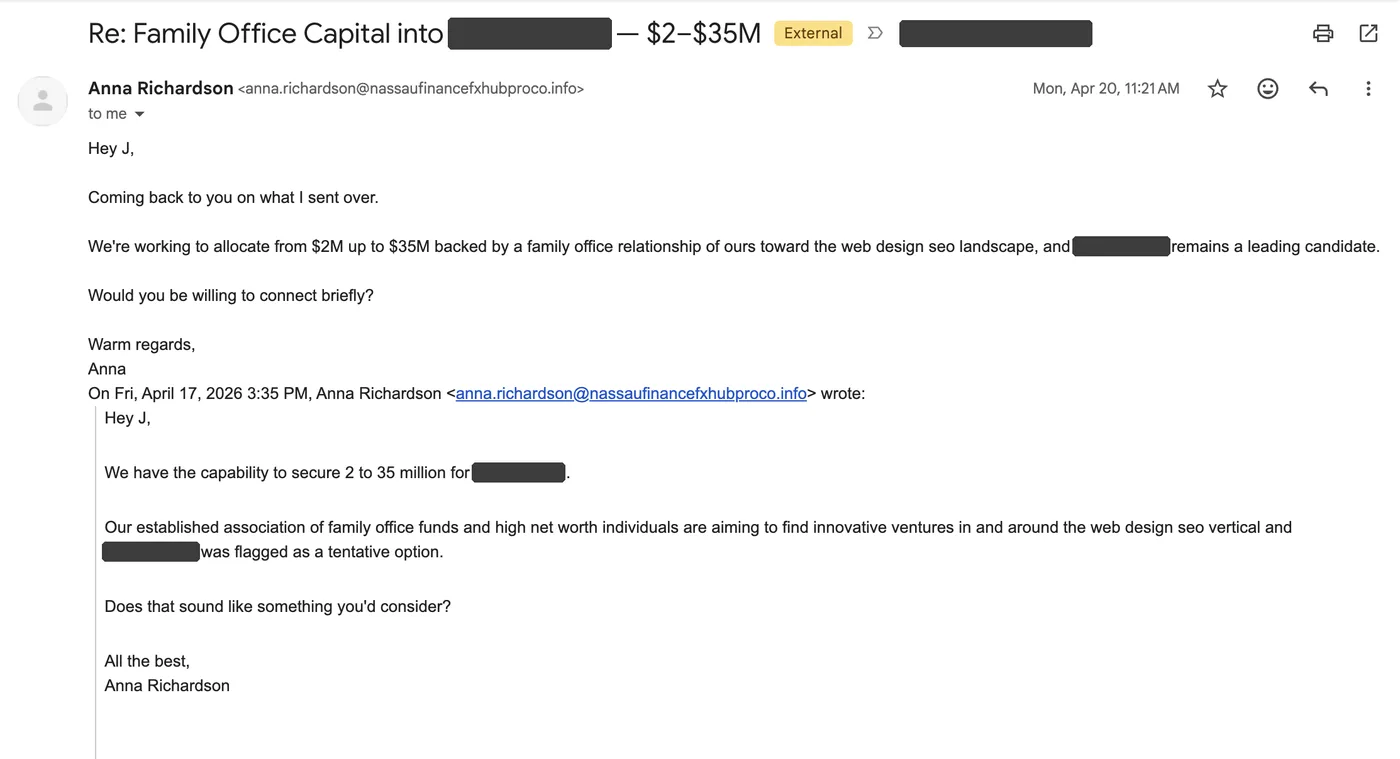
They come from different names and different domains, but the script barely changes. A sender I’ve never heard of says their “family office relationship” or “network of high-net-worth individuals” is looking to invest in my sector, and that my company “was flagged as a tentative option.” Then they ask if I’d be willing to connect.
A few things stand out once you’ve seen a handful of them:
- The money is huge and vague. “From $2M up to $35M” isn’t an offer. It’s a range wide enough to cover any business that might reply.
- The firm is never named. It’s “a family office relationship of ours” or “the group I work with,” never a fund you could look up.
- The domains are throwaways. Mine came from addresses like nassaufinancefxhubproco.info and nassauventureplannerslabs.info. The first one was registered in late February 2026, a few weeks before the emails started.
- The same template keeps coming back. Different senders, same wording, sometimes the same subject line with a different dollar figure.
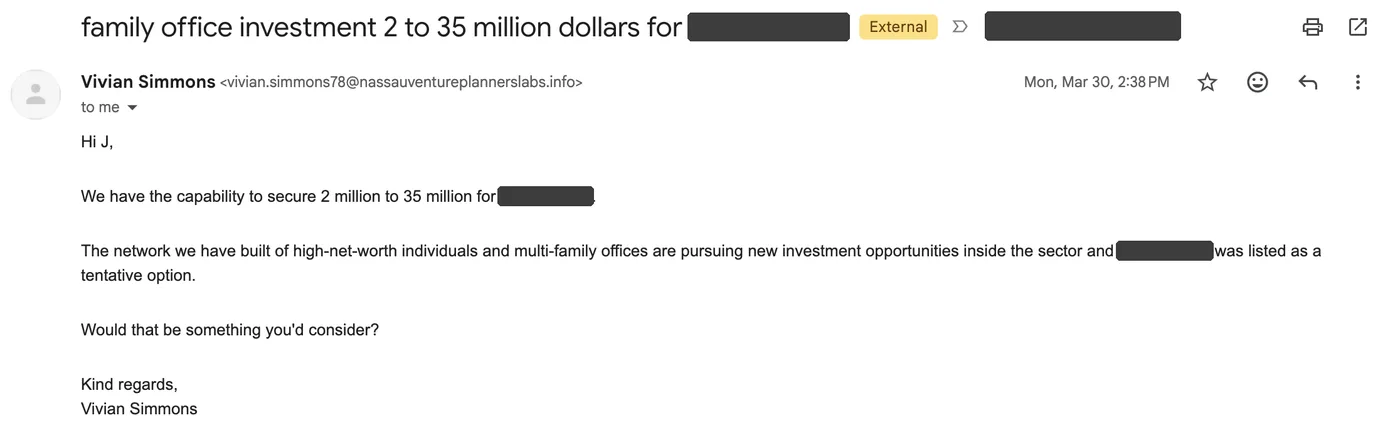
Real investors do cold outreach too, but they tell you who they are, they have a website and a track record you can check, and they don’t send the same paragraph to every business in a category.
What they actually want
The pitch is flattering on purpose. Someone who thinks a buyer or investor has picked them out is more likely to reply, take a call, and share things they normally wouldn’t. In July 2026, ConsumerAffairs reported on a closely related wave, emails claiming a private equity firm or family office wants to buy your business, and listed what the senders tend to be after:
- Your contact details. A reply confirms that your address is live and that a real owner reads it. That alone makes you worth selling to brokers and other spammers.
- Upfront fees. Eventually there’s a “due diligence fee,” a valuation report you have to pay for, legal fees, or an escrow deposit before the money can move. Once you pay, the investor disappears. This is a classic advance-fee scam.
- Your business data. Revenue, customers, suppliers, and how you get paid. That information has value on its own, whether or not a deal ever happens.
- Your logins. An NDA, a letter of intent, or a questionnaire that’s really a link to a fake sign-in page or a file that installs malware.
- A setup for payment fraud. Knowing who you bill, who you pay, and how, is exactly what someone needs to impersonate you or your vendors and redirect a payment.
None of these requires the “investment” to exist. The deal is just the reason to keep you talking.
Is the Calendly link dangerous?
Calendly itself is a legitimate scheduling tool, and plenty of real businesses use it. The problem is that scammers use it too, precisely because a Calendly link looks normal and trustworthy.
Security researchers have documented a few ways these links get abused. A booking page can carry a custom link that leads somewhere else, such as a fake Microsoft or Google sign-in page that steals your password, and in some campaigns can get past two-step verification too. Some links aren’t Calendly at all, just a page dressed up to look like it on someone else’s domain. And in a 2024 campaign covered by TechRadar, scammers posing as crypto investors booked a video call, then sent a “fixed” meeting link that showed a fake error page and talked Mac users into running a “fix” that installed malware.
So my instinct not to click wasn’t paranoid. The usual danger isn’t the click by itself, though. It’s what comes after: a page asking you to sign in, a file to download, a “meeting app” to install, or a code to type in. If a link to book a meeting ever asks for any of those, close it.
The funding version
Not every one of these is about buying or investing in your company. One sender, who wrote in October 2026 saying she and her partners were “interested in backing” my company, turned out to be selling something else once I replied.
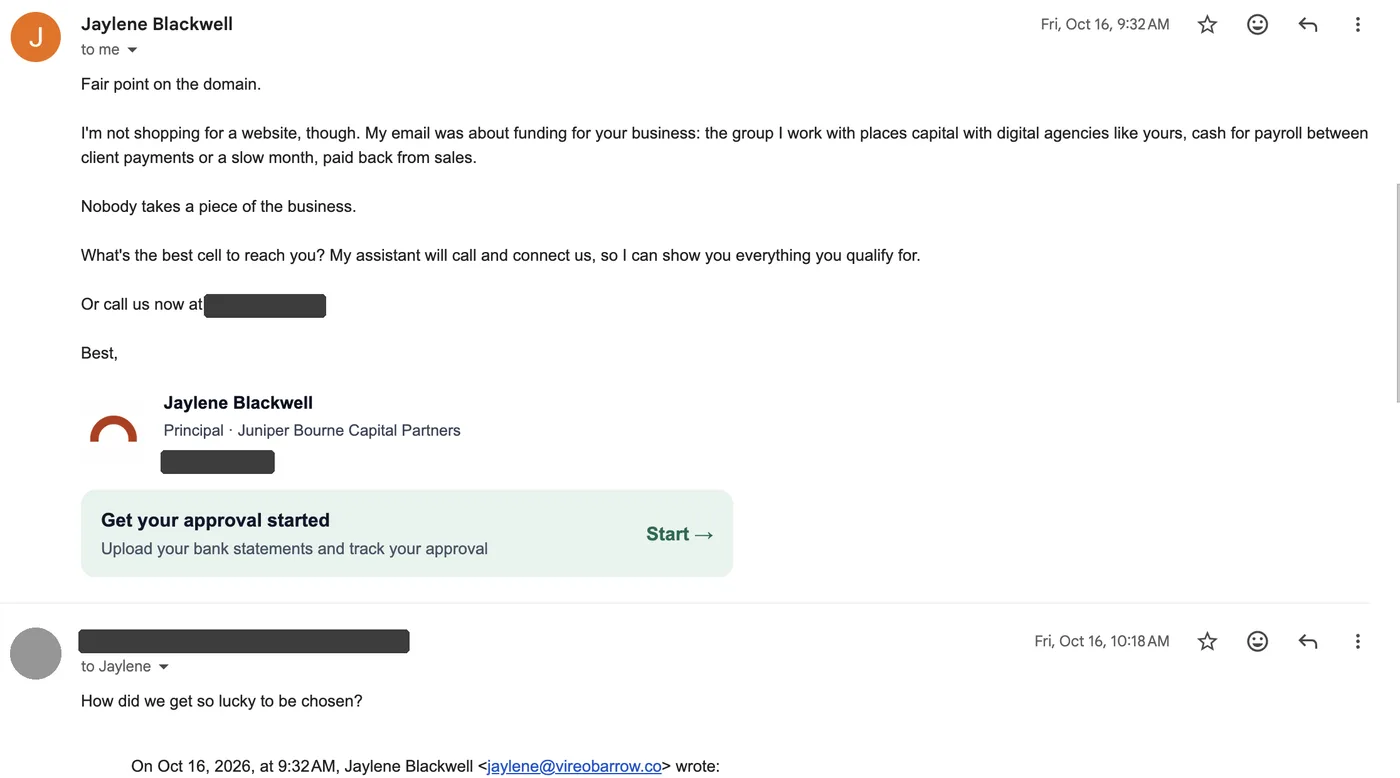
When I pushed back, the pitch changed. Suddenly it wasn’t an investment at all. It was “cash for payroll between client payments or a slow month, paid back from sales,” and “nobody takes a piece of the business.” That’s how merchant cash advances are pitched. With a merchant cash advance, a company gives a business money upfront in exchange for a larger amount, typically collected through frequent automatic withdrawals from its bank account. It’s generally legal, but it can be expensive, and the US Federal Trade Commission has taken action against several providers for misleading small businesses and pulling money from their accounts without consent.
The signature had a button that read “Upload your bank statements and track your approval,” and every reply asked for my “best cell.” That’s the real goal. Bank statements show your account details, your balances, who pays you, and who you pay. A phone number gets you onto a call, where pressure works much better than it does in an inbox.
The sender also named a firm and a website, which sounds reassuring until you look. I couldn’t find any trace of that firm outside the emails themselves, and the address she wrote from was on a different domain entirely.
What happens when I reply
I usually don’t reply, because I’m almost certain they’re scams. But sometimes I have a bit of free time, and I can’t resist having a little fun.
I tell them they have a crappy domain name, and that they could scam… I mean convince more people they’re legit if they used a better one. Then I offer them a few options available on whitmark.com. I usually don’t hear back after that.
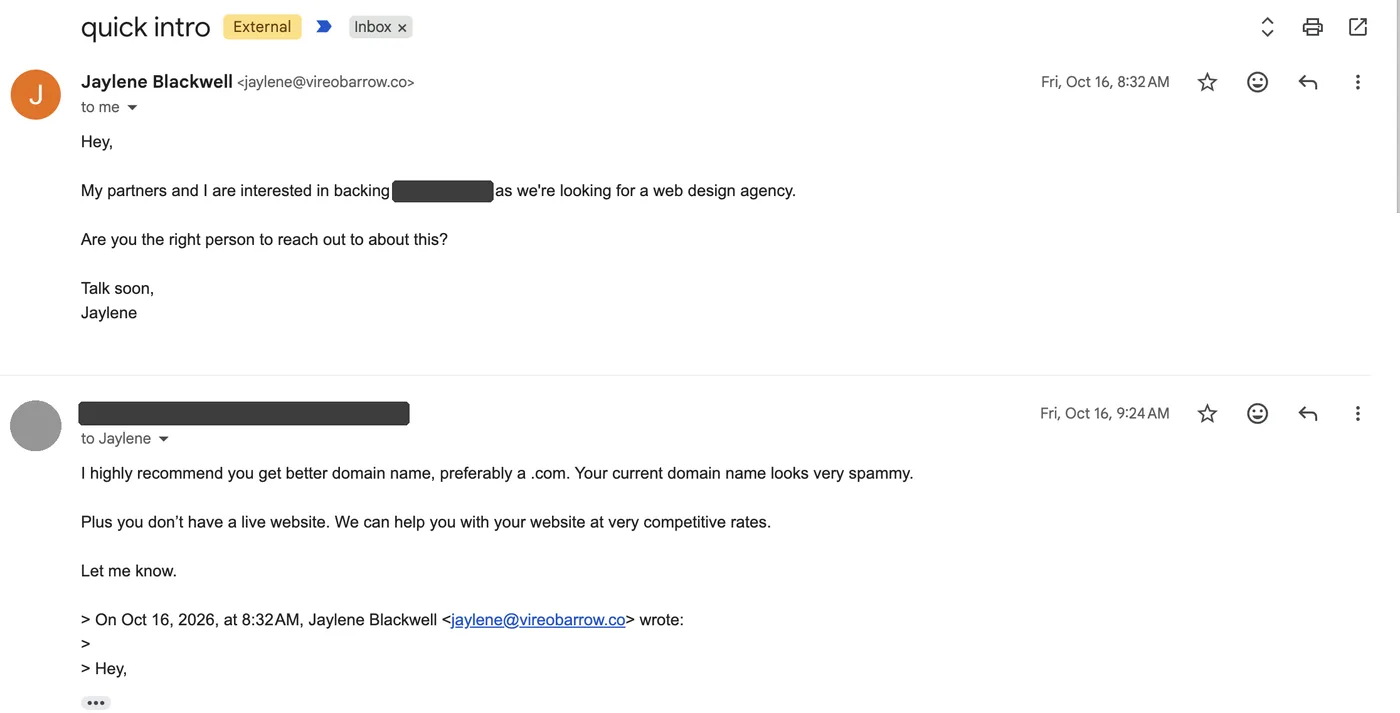
Every now and then, though, I get an obtuse one on the other end who’s so intent on getting me on the hook that they ignore whatever I said. The funding sender above did exactly that. “Fair point on the domain,” and straight back to the script. When I asked how they found us, I got a non-answer twice. Then the follow-ups started: two in early November, including “just floating this back to the top of your inbox,” and a third on November 12, “just bumping this up in case it got buried.” Gmail sent that last one straight to spam because it looked like messages already identified as spam. That’s what a script or an automated sequence looks like, not a person who has read my email.
I don’t recommend replying, by the way. Even a joke confirms your address is live. I just happen to have domains to sell.
Red flags to watch for
Any one of these on its own might have an innocent explanation. Two or three together should end the conversation:
- You never asked for investment, a loan, or a buyer, and you’ve never advertised your business.
- The investor or buyer isn’t named, or the named firm leaves no trace anywhere except the emails.
- The sender’s domain is new, odd, or doesn’t match the firm they claim to represent.
- The amount is large, round, and not tied to anything about your business.
- They push for a call or your cell number before telling you anything concrete.
- They ask for bank statements, financials, or a fee before any real deal exists.
- They ignore what you write and keep repeating the pitch.
What to do with these emails
The short version is don’t engage. If you want to be thorough, here’s what’s worth doing:
- Don’t click the links or book the meeting. If you’re genuinely curious, look the firm up yourself rather than using anything in the email.
- Check the domain. A tool like ICANN Lookup will show when a domain was registered. If a supposed investment firm’s domain is only a few weeks old, treat that as a major red flag.
- Never send money or documents. Don’t send bank statements to anyone you haven’t verified independently, and no legitimate investor or lender asks for an upfront fee before the money exists. The FTC’s advice on advance-fee loans applies here too: no one legitimate will ever ask you to pay for a promise.
- Mark it as spam. That helps your email provider catch the next one from the same senders.
- Report it. In Canada, you can report it to the Canadian Anti-Fraud Centre online at reportcyberandfraud.canada.ca or by phone at 1-888-495-8501, whether you lost money or not. In the US, report it to the FTC at reportfraud.ftc.gov.
If you’ve already shared logins, change those passwords right away and turn on two-step verification. If you’ve sent bank details or money, call your bank first, then report it.
The good news is that these emails are easy to ignore once you know what they are. Nobody is going to wire you $35 million because your company “was flagged as a tentative option.” If it sounds like you’ve been picked out of nowhere, you probably have been, just not for the reason they say.
Top photo: Alejandro Escamilla / Wikimedia Commons (CC0). Screenshots: emails received by the author, with identifying details redacted.